Showing posts with label 18th century France. Show all posts

Friday, July 31, 2015

Review: Sally Christie's "The Sisters of Versailles"

Hello dear readers!

Today I bring you a review of Sally Christie's upcoming novel, "The Sisters of Versailles". I was immediately excited upon sighting the novel on Netgalley and I was not disappointed. Christie explores the previously neglected reign of Louis XV and the result is nothing short of page turning.
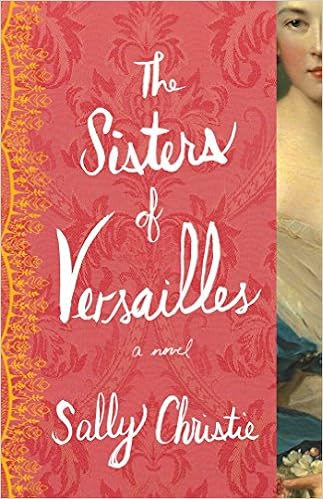
This fascinating fictional (but still accurate) account takes on the lives of the notorious Mailly-Nesle. The five sisters--Louise, Pauline, Diane, Hortense, and Marie-Anne were brought up in the shadow of Versailles and expected to marry well. Instead, four of them become royal mistresses. Louise is the first to go to Versailles and capture the heart of King Louis VX. Naive and pure of heart, Louise is Louis's first documented mistress, but her unaffected ways and sweet spirit are overthrown by the arrival of Pauline. Described in the novel as "a force of nature", Pauline is determined to seduce the king and make a name for herself. The two sisters co-exist in a strange menage trois until Pauline's death leaves a void. Then Diane, Hortense, and Marie-Anne arrive on the scene, but it is the youngest Mailly-Nesle sister who impacts the king in ways previously not seen. Marie-Anne is determined to use her position to live the good life, but there are always sacrifices and consequences.

Louis XV's fascination with the Mailly-Nesle sisters was certainly a unique situation and one that has been surprisingly unexplored in the past. Sally Christie brings all five sisters to life, alternating each chapter with a new voice and view. The fact that each sister's voice is distinct is clear evidence of Christie's talents as a writer. The reader in turns will find themselves laughing with, rolling their eyes at, or downright hating the sisters. This lovely novel is not to be missed! There were many nights that I stayed awake long past my bedtime because I didn't want to put it down. It hits bookshelves on September 1, 2015 and can be pre-ordered through Amazon.

Wednesday, March 19, 2014

Review: Becoming Josephine by Heather Webb.

Hello my darlings.

Up today is my review of Heather Webb's Becoming Josephine. I received a copy from Netgalley in exchange for my fair and honest review (of course). The novel is an interesting look at the evolution of Rose Tascher de la Pagerie to Rose de Beauharnais to Josephine Bonaparte. Josephine has been a popular subject over the years; most recently Sandra Gulland devoted a three book series to Josephine's rise from plantation raised Creole to Empress of France.

Ms. Webb's novel opens in Martinique where Josephine began her life as Rose Tascher, the daughter of a wealthy, womanizing plantation owner. When her younger sister Catherine dies, Rose is sent to France to marry Alexandre de Beauharnais. Their marriage is fraught with discord though Rose eventually bears two children--Eugene and Hortense. Interestingly, she successfully seeks a separation from Alexandre who devotes most of his time chasing women and spending his inheritance.

Rose is depicted as smart and resourceful even though she is very unlucky in love. Despite her husband's numerous affairs, she never is unfaithful to him. It takes the French Revolution and the eventual imprisonment of both Rose and Alexandre for them to reconcile, though their friendship is cut short by his execution. Through her winning ways and kind nature, Rose is released after the death of Robespierre, and sets about remodeling herself into the ideal Republican socialite. She takes many lovers, and eventually becomes the mistress of Paul Barras, an influential politician. It is he that introduces her to Napoleon Bonaparte, a rising general. Once married, Rose becomes Josephine.

There are many things to like about Becoming Jospehine. It is an interesting and fast paced narrative.
It covers a lot of ground without getting too bogged down in the vast political landscape that it covers. Some may see that as a drawback if they are looking for more information on the Revolution and the subsequent Directoire period that led to Napoleon's ascent. Josephine is a multi-faceted character and the reader feels every change. Starting out as a young, naïve bride, she eventually becomes jaded and rather mercenary, but then ends the novel as a diminished, but proud ex-empress. It is during her middle period that she seems at times obsessed with gaining her financial independence either through business dealings or taking a wealthy lover. The fact that she morphs into this "do as you please" type of woman may leave a sour taste in some readers mouths. Even after her marriage to Napoleon, she continues her affairs until suddenly realizing that she truly loves her husband. Then once again she is put at a disadvantage as Napoleon takes mistress after mistress. His egomania is blamed of course, but then comes the inevitable divorce. The reader can't help but feel sorry for Jospehine as her fall comes as quickly as her ascent. Even though her divorce is painful, Josephine walks away content that she can live her life in relative obscurity. The irony of this situation is that it is Josephine's heirs eventually rule France and marry into some of Europe's greatest dynasties.

Additionally, the novel is not very strong in its nuances of the period. There are several instances of words being used that may have been present in the time period, but felt entirely too modern. "Vacation" is used several times, and Josephine entreats her daughter Hortense to say "hi" at one point. Despite these drawbacks, Becoming Josephine will appeal to many readers, especially those who are not hard core historical fiction lovers. But those who prefer their historicals with a little more depth, may decide to pass on this one.

Thursday, November 15, 2012

Cecilia's World

I'm pleased to present my newest heroine Lady Cecilia Compton St. James, Duchess of Stanhope. Quite a mouthful, eh? She is the center of my current work-in-progress A Scandalous Bargain. The novel opens in 1753 with a thirteen year old Cecilia being married off to Lord Aubrey St. James, the Earl of Stafford. Soon after the wedding, she is sent to Paris to be educated at the Abbaye Royale de Panthemont. So let us start off there.

 Abbaye Royale de Panthemont was a convent founded in 1217 that eventually developed into a high class finishing school for daughters of the aristocracy. The current buildings were begun in 1747 as a result of a re-building campaign undertaken by the abbess Marie-Catherine de Mezieres Bethozy (say that three times fast). Despite having several wealthy patrons, the construction stretched out for decades. The chapel was consecrated in 1756 and finished in 17663, while the convent was not completed until 1783, just in time for the revolution. Since Cecilia is a lodging student during the major construction period, I made sure to mention it. It is the abbess who informs her that she is to return to England after her husband inherits his father's dukedom. Cecilia is not totally ignorant of the ways of love and sex, and yet she notes that all is not sanctimonious at the convent. Indeed convents had a rather nasty reputation for being dens of sin and vice. Italy seems to be the worst offender when it comes to salacious activity, but France had its own stories. In fact, the Marquis de Sade wrote about the Abbaye in one of his books, Juliette. "The prettiest and most immoral girls in Paris come from the Panthemont convent."

Since de Sade was rather scandalous and maybe not entirely truthful, I chose to err on the side of caution when Cecilia muses about her experience in the convent:

The convent was not so sheltered that she did not understand what went on between a man and a woman. There were married aristocratic women lodging here who were free in their speech--and hatred for the demands their husbands had placed upon them. Then there was the occasional student or even novice nun who fell pregnant and Cecilia was sure that the conception of such children was not immaculate.

Despite the rumors, the convent had several wealthy and famous students grace its halls before it was disbanded by the Revolutionaries in 1790. The Countess de Polastron was educated there before becoming the lover of the Count d'Artois (so maybe the rumors were true). Josephine de Beauharnais allegedly stayed in the convent when she was attempting to separate from her husband. Thomas Jefferson's daughters Martha and Polly lodged there in the 1780s--but only after TJ had received assurances that they would not be converted from their protestant faith. Nonetheless, Martha still wanted to convert and Jefferson was forced remove her and her sister before they fled the country on the eve of the French Revolution.

You can still find the convent in the 7th arrondissement of Paris though it bears little resemblance to the original buildings that once occupied the site. Today it is a protestant church named the Reformed Church of Luxembourg-Pentemont.

That's all for now. What subjects do you most enjoy researching when you are working on a book?