Showing posts with label Gilded Age. Show all posts

Tuesday, August 22, 2017

Review Tuesday: "The English Wife" by Lauren Willig

Hello all and thank you for tuning in. I know I've been sporadic at best with my musings and reviews in the last couple of years. I'm aiming to change that, but I will detail those changes in a different post.

So... "The English Wife" by Lauren Willig. I will say that I was a huge fan of Willig's first few books in the "Pink Carnation" series. Her writing was witty and fun, while combining great historical stories with modern day story lines. Now around the fifth entry of the series, I tapped out. I'm not a fan of the never ending series, no matter how good it is. So when Willig started writing standalone novels, I sat up a took interest. I tried reading "The Other Daughter" and just couldn't get into it. But "That Summer" returned to the formula of combining a modern day mystery with a historical plot line and I was hooked.
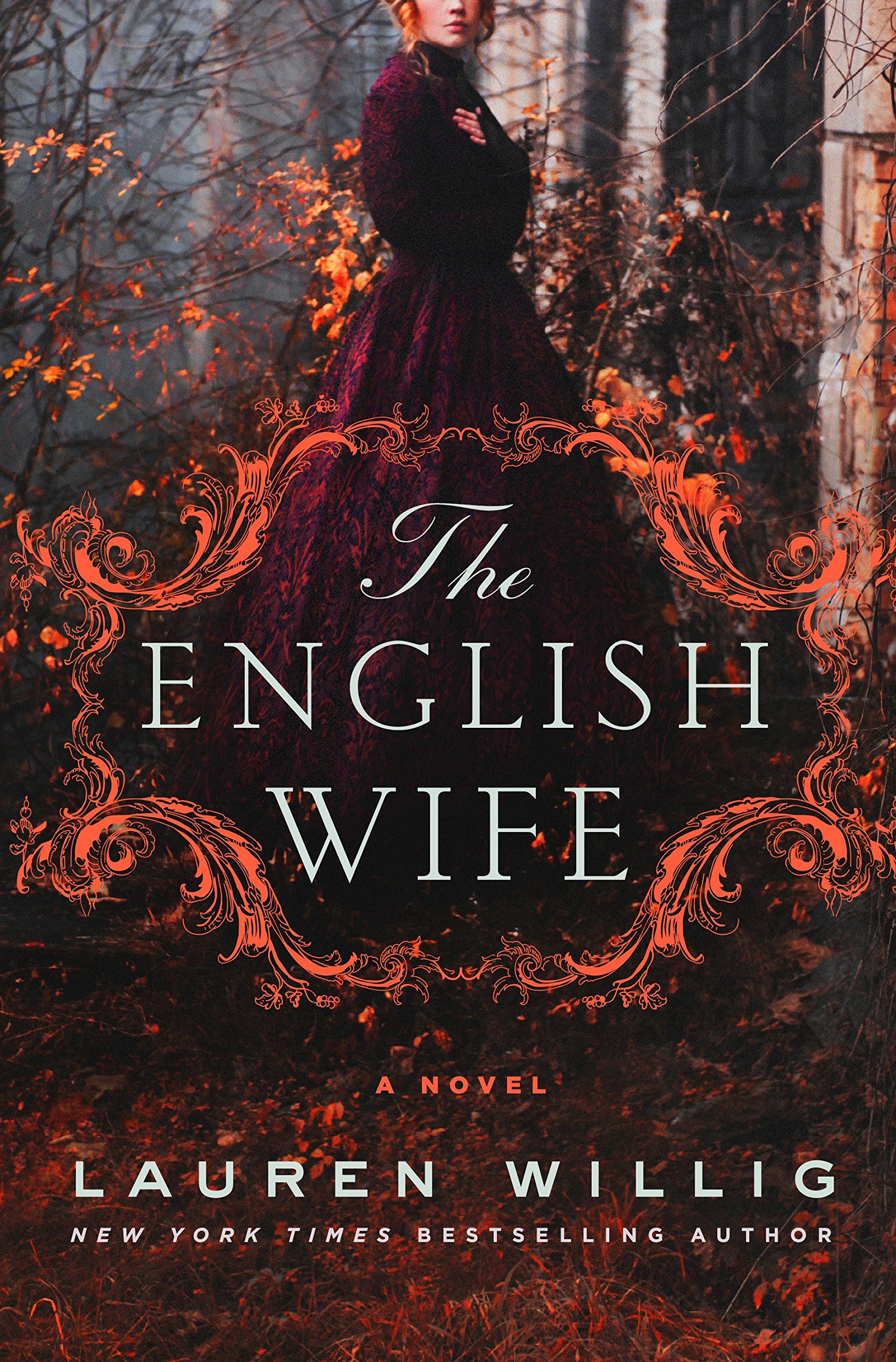
"The English Wife" returns to a wholly historical plot and it is done very well--to a point. Though now that I think of it, it would have been interesting to see it in the same format at "That Summer" with a modern day protagonist trying to solve a historical mystery. But I digress.

"The English Wife" is set in Gilded Age New York, and told from two perspectives--Janie Van Duyvil and Annabelle Van Duyvil. The catch is that Janie is telling the story from 1899 and Annabelle is slightly in the past (1895). The two women tell their stories until the timelines match up in the end, which is rather clever. Janie is the daughter of a distinguished, monied New York family. As the novel opens, her older brother Bay has been murdered and his beautiful English wife Annabelle is missing. Janie is determined to solve the mystery as she is convinced that her sister-in-law would have never murdered the man she loved.

Janie teams up with Burke, an intrepid news reporter with no love for New York's aristocracy. Their attempts to discover the real killer are interspersed with flashbacks featuring Annabelle. Before she met Bay Van Duyvil, she was an actress in a burlesque show, fleeing from her past. She meets Bay on a whim, and is immediately distrustful, but their shared love for Shakespeare joins them together. Their friendship blooms into love and love into marriage, but it is not long before cracks begin to show. What results in the end are devastating secrets being revealed.

"The English Wife" was a page turner for the first two hundred pages or so. But as the novel should have been climaxing, it just ran out of steam. I actually sat it down for several days and only picked it up today to finish. I loved Janie, who was truly trying to be the good daughter, but in the end decided to follow her heart. Annabelle and Bay's story is heartbreaking; their characters were both flawed, and as a result, their marriage becomes a sham. So what went wrong? For one thing, I just could not buy into who Willig chose to commit the murder. It makes sense on the surface, but there were other characters that had better motive. While I applaud Willig for taking the road less traveled, the result was forced, and frankly, nonsensical to a point.

So would I recommend the novel? Sure. The suffocating atmosphere of Gilded Age New York is done well and lends a darker feel to the novel. I enjoyed it and I'm looking forward to reading whatever Willig has up her sleeve next. I really liked the fact that "The English Wife" was a true departure from her other historical novels. The book is out on January 9, 2018 and is available for pre-order on Amazon and all the other usual places. A big thanks to Netgalley and St. Martin's Press for the advance copy.

Tuesday, April 12, 2016

Review Tuesday: "These Shallow Graves" by Jennifer Donnelly

Happy Tuesday to you all!

As you know, today is Review Tuesday, which when I say that in my mind, it's in a sonorous voice and it echoes. Yes, I am short a few. :-)

Today I bring you my review of Jennifer Donnelly's These Shallow Graves. Have I ever mentioned my absolute and undying love for Jennifer Donnelly? I have been a major fangirl since I picked up her first novel The Tea Rose during finals weeks in college and it's a major miracle that I didn't fail because all I wanted to do was to read that novel. Donnelly has since moved on to other subjects including a dual-period novel entitled Revolution and a teen series focusing on the myths surrounding mermaids, so when I saw that she was publishing a new Victorian era novel, I was super stoked. These Shallow Graves is geared towards young adults but it still a wonderful novel that captures a lot of the grit of Gilded Age New York that was featured in her first novel.

The story follows Jo Montfort as she longs to test the glittering restrictive world of her birth. As one of New York’s elite, she has been raised to marry the perfect gentleman and have babies; but what Jo really longs for is to pursue her love of journalism. Her world is rocked when her father is discovered dead, a supposed suicide. Not believing her father capable of such a thing, Jo teams up with newspaper reporter Eddie Gallagher to uncover the dark secrets lurking just out of sight. She will risk her heart and social oblivion to discover to the truths that threaten to challenge her perfectly planned existence.

Jennifer Donnelly truly excels at historical fiction, whether it be for adults or teens. While These Shallow Graves is geared towards young adults, it will intrigue adult readers as well. At first the heart of the mystery seems easily solved, but as Jo and Eddie continue to uncover pieces to the puzzle, the real truth becomes further obscured. Descriptions of Victorian New York really give the novel its flavor while the characterizations are equally wonderful. So many female protagonists in today’s historical fiction are not in sync with the realities of their time periods. Jo Montfort is very aware of her place in society and the constraints upon her as a woman. She is constantly barraged with who she is and how she should act, which reminds the reader of how life used to be. But Jo is wonderfully smart and courageous, and though she challenges the establishment, she does it with grace and deportment.

I definitely recommend These Shallow Graves and basically anything by Donnelly so pick up a copy today.

**This review appeared the Historic Novel Review in February 2016.

Monday, September 24, 2012

A Buccaneer Love Match


Mary Leiter, future Baroness Kedleston
 
I'm still knee deep in stories of the Gilded Age but instead of cautionary tales of social marriages gone sour, I thought I would detail the love match of Mary Leiter and George Curzon, Baron Kedleston.

Mary Leiter was the daughter of Chicago businessman Levi Leiter, who co-founded the Marshall Fields department store empire. She was one of the second generation Buccaneers who was highly educated, beautiful, and adept at all those social niceties so coveted by young ladies the world over.
After spending time on Dupont Circle in Washington, D.C., Mary (who was BFFs with first lady Frances Folsom Cleveland) did the obligatory tour of Europe before landing in London in 1894. There she met George Curzon, an enterprising journalist, world traveler, politician, and heir to the Barony at Scarsdale. They both seem quite enamored of each other, but strangely enough, they went their separate ways at the end of the season. Mary went back to Washington and George continued to gallivant the East Indies.

George Curzon, Baron Kendleston
But absence must have made the heart grow founder, for George turned up in Washington the next year, and the couple was married soon after on April 22, 1895 at St. John's Episcopal Church. Of course they hared it back to England, where George went from one political victory to the next, and soon the couple was headed to India as the Viceroy and Vicerine in 1898.

They lived in India for many years, where Mary was known for her society shindigs and philanthropy. The couple had three daughters--Mary, Cynthia, and Alexandra--all of whom either slept with or were married to the famous socialist Oswald Mosely. As was their future stepmother. Um, gross?

Sadly, Mary suffered greatly from a miscarriage and never fully recovered. Apparently she underwent some sort fertility related surgery as well in an attempt to conceive a son for dear George's barony. She died in London in 1906 at the age of thirty-six. George was so distraught that he erected a memorial chapel for her remains on the grounds of Kedleston Hall.
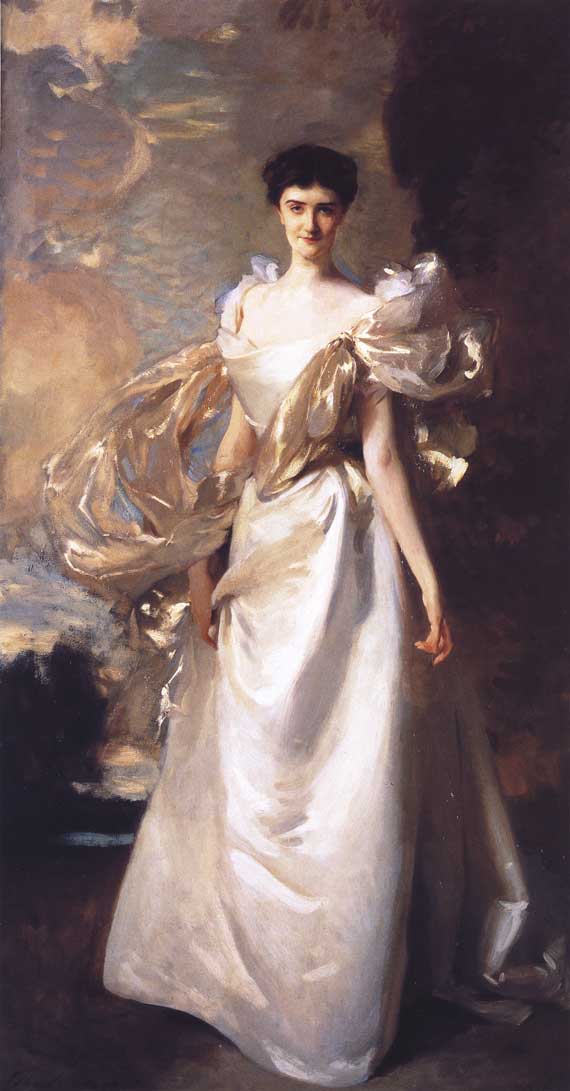
Margaret "Daisy" Leiter by
John Singer Sargent
Back briefly to the Leiter family, who were quite extraordinary in their own right. All the sisters went British. Nancy Leiter became the wife of Lt Colonel Colin Campbell and was known as America's most beautiful woman for a time. She met Campbell while visiting her sister Mary in India.

The other Leiter sister Margaret, better known as Daisy, was also a successful buccaneer. She married Henry Howard, the 19th Earl of Suffolk (and 15th Earl of Berkshire) in 1904.

In 1931, the Leiter family was divided when Daisy sued her brother Joseph over his mismanagement of their father's multi-million dollar estate. The lawsuit dragged on for eight years and racked up over a million dollars in court and attorney fees. Though Joe's tastes were extravagant (he famously purchased some 50 dozen pairs of silk socks and at one point tried to buy the Great Wall of China), the court refused to intervene since he had managed to increase the estate's working capital from 12 million to 17 million. However, when a special audit was conducted six weeks later, Joseph voluntarily resigned. When he died the next year, his personal estate was worth a million dollars. Daisy was still living in London when a 1937 Time Magazine article documented the trials and tribulations of the fabulous Leiter family.

Tuesday, September 18, 2012

The Gilded Age or My Homage to the Vanderbilts

Biltmore, ca. 1900
I've always been fascinated by the Gilded Age. The clothes were luscious (if you didn't mind being trussed up like a turkey), the houses were huge, and being socially mobile was all the rage. I grew up taking day trips to the Biltmore Estate in Asheville, North Carolina (I highly recommend a visit to both the estate and the city...fabulous architecture, awesome food, and good beer...what else could you want?) and so my childhood fantasies were filled with thoughts of the Vanderbilts. Even though I have visited the estate mulitple times, I never get tired of it. In fact, my hubby and I paid a visit back in April and I was finally able to see the gardens in all of their spring glory thanks to a particularly warm winter. They've added many new features including period clothing to some of the rooms and we were lucky to catch the opening of a new history exhibit that satisfied my obsession for all thing Vanderbilt.


For those of you not familiar with Biltmore, it was built in the 1890s by George Washington Vanderbilt, the grandson of the original Robber Baron, Cornelius Vanderbilt. I don't really think he did anything besides inherit millions of dollars (OK, apparently he managed the family farm in upstate New York). He was rather sickly and upon a visit to the Asheville area, he decided that a mountain estate was just what he needed for his health. He commissioned Richard Morris Hunt (my favorite architect of the era) to design the house and Frederick Law Olmstead (yes, that Olmstead...of Central Park fame) to do the gardens. Ten years later, George moved into the palatial estate, along with his wife Edith Stuyvesant Dresser, a pedigreed old New Yorker who was raised in Paris. Her fabulous portrait by Boldini hangs in the house. She was quite tall apparently!

The house today remains intact and owned by Vanderbilt's grandsons. It is also the largest privately owned residence in the US and I am always marveled by how the family has turned such a palatial estate into a million dollar business.

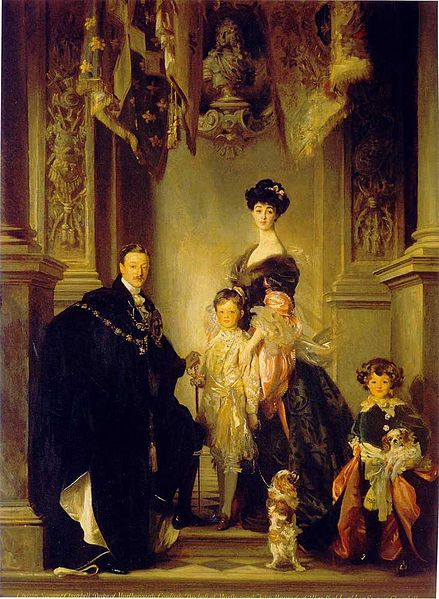
Lovely family portrait of the Marlboroughs
by John Singer Sargent

As I grew older and my interests began to extend to all things British, I became fascinated by another Vanderbilt--Consuelo, the Duchess of Marlborough. She was George's niece, the daughter of his brother William Kissam Vanderbilt and the pugnacious Alva Erskine Smith, who from all accounts was someone you did not want to cross. I've been reading To Marry An English Lord: Or How Anglomania Really Got Started and it details all of Alva's machinations to obtain entree into New York society (it's a tongue and cheek account of the time period...very funny). Consuelo was named after her mother's BFF, Consuelo Iznaga, who was one of the original "Buccaneers" -- she married the Viscount Mandeville who eventually became the 8th Duke of Manchester.

It was fitting that Consuelo Vanderbilt became one of the second generation "Buccaneers". She married Charles, the 9th Duke of Marlborough, though sadly, their marriage was loveless at best. She gave him "the heir and the spare" and checked out around 1906 with their divorce being finalized in 1921. She went on to marry the French aviator Jacques Balsan, who incidentally, was the brother of Etinenne Balsan (one of Coco Chanel's early lovers). Small world!

Consuelo was recently used as a model for Cora Cash in Daisy Goodwin's novel "The American Heiress". Many of the incidents (domineering mother, a secret engagement) in the book were ripped from Conseulo's own autobiography "The Glitter and the Gold".

That's enough for today. I might detail more on the other Buccaneers (including Consuelo's aunt-in-law Jennie Randolph, mother of Winston Churchill) at a later date.