Wednesday, February 13, 2013

So I Lied.

OK, I didn't lie. I just changed my mind. As many of my loyal followers/readers know, I do that quite often. Probably more so than is advisable. What did I change my mind about? An Convenient Misfortune. After becoming aware of the fact that American set historicals may be on the upswing, I took the novel back to its original premise. Meaning that its back to being set in Charleston (or Charlestown) during the American Revolution. What steered me back? A brainstorm! How I love those!

An Convenient Misfortune has always been a dead end. The original draft was never finished...it just peetered off around page 320. I fell victim to the same folly that afflicted me with Rebel Heart--I failed to plan an exit strategy. Yeah, endings are hard. They're my kiss of death though. But in a blinding flash of light I figured out what I'm going to do. Actually I figured out two endings and I'm going to see where the progress of the book leads me. The new blurb is...

It's 1776 and Arabella Westbury is forced to leave everything behind in England when her father is assigned to a church in the South Carolina colony. When he dies on the voyage, she is left an orphan with no prospects in an environment that is hostile to British subjects. Despite her nationality, Arabella uses her wits to find work as a governess with the Bennetts, a prominent Patriot family.
When her charge's older brother Jackson comes home from sea, sparks fly. And when Arabella discovers his secret, she is forced into a marriage of convenience with him, which leaves his spurned fiancee burning for revenge. As the American Revolution grows closer to Charlestown, friends will become enemies and Arabella will have to make some dangerous decisions that could land her in prison...or worse.


So what about you? Are endings tough or so they come naturally? Do you plan ahead or do you let the plot show you the way?

Tuesday, January 22, 2013

Plotting, Writing...Re-Enacting?

So I am pleased to say that I have been doing some "writerly" things of late. I made a decision to start using my lunch hour to write on the various WIPs I have. A big thanks to those who encouraged me in my last post. I'm still not chomping at the bit to write, but at least I will have some time on a daily basis to put down some words and hopefully get everything finished out. I have been thinking about joining a local writer's group as well. I've wanted to in the past, but I never got around to it. I may need some distraction in the coming weeks as hopefully my husband will be getting back into law enforcement, which means he'll be super busy for 12 weeks for training so I will need to find something to fill my evenings!

I have done some re-plotting for my WIP that just will not die... As you faithful readers will know, A Convenient Misfortune has been with me since high school. I tinker with it every so often but something didn't feel right about it so I shelved it. I couldn't just put it away so I started contemplating moving the story to England (instead of the American Colonies--Charleston (Charles Towne to be exact). It was set during the American Revolution originally, but I've toyed with the idea of moving it back a few years to be set during the Seven Years War (French and Indian War for those of us who are stateside). It could go either way, to be honest. But so far, here is a very dirty version of my back cover blurb:

Arabella Westbury is sailing for England--leaving her broken heart behind in the South Carolina colony. She has nothing to her name save for a few trunks of books, relics of her father's time as minister at St. Michael's Church in Charles Towne, and her memories of a lost love for a planter's son. Her destination is Cornwall and the village she was born into some eighteen years before. Once there she will have to forge a new life as governess to Marianne Bennett, the youngest daughter of a wealthy baron. But it is the Bennett family scion that causes Arabella consternation.

Handsome and reckless, Jackson Bennett is a decorated British Navy captain who comes and goes as he pleases, breaking hearts in his wake. But when he returns home after being wounded in battle, there is a new urgency for him to marry and provide an heir to the vast Bennett family fortune. Arabella is an unlikely candidate but after his secret engagement to a local heiress goes sour, Jackson has no choice. He marries the governess out of convenience and hightails it back to his ship, leaving his new wife completely adrift in a new world of social niceties and betrayals.

When he returns, he will find many surprises, including his abandoned wife's hatred for him. Winning her back is no mean task and the situation is only complicated when a man from Arabella's past arrives in Cornwall. Can he convince his wife that he wants more than a marriage of convenience before he has to leave for the high seas once more?

Interestingly enough, I just made a few of those plot points while I wrote out the blurb. Talk about off the cuff! I keep thinking that the plot is just not complicated enough, so let's what other complications I dream up in the mean time.

Looking very tired, so not the best picture...but you get the idea!
In other news, I just attended my first Revolutionary War re-enactment of the year over the weekend. Well actually it was a living history event and was kind of boring without a battle, but not so boring if you count all the things I have to do in camp. It is times like this that I realize how hard women had it in past times...and I can see why the death rate was so high. Diseases of course, but how about just being plain worn out? You have to keep the fire going, cook, wash up...throw in kids and no wonder it was early to bed, early to rise! Nonetheless, I love history (obviously) and I love to dress up, so re-enacting is an amusing diversion for me, not to mention the best way to research for my novels. Nothing brings you closer to the past than re-enacting it!

So with the new year come and gone, are you keeping your writing resolutions? What do you do to get in touch with your characters?

Thursday, December 20, 2012

Getting Started is the Easy Part...

New ideas are always compelling. They crowd in on me as I excitedly string together each plot point until I have a whole new novel. I sit down at the keyboard and dash out page after page after page...and then nothing. I stare at the blinking cursor and nothing. I go away for awhile...a few days perhaps, a week, and then I open the document again. I re-read pages, crack a smile at something particular amusing or sometimes brilliant, my fingers hover over the keys. I type a sentence or two and then something distracts me. I have a thought so I dash off to look it up on the internet which turns into a three hour affair and before I know it's time to go and I save my paltry few lines.

Rinse and Repeat.

I've been thinking a lot this week about what sparks my imagination and why I can't seem to focus. I have two really great WIPs right now and yet I just can't get excited about them. I'm assuming that I can't get excited about them because if I were, wouldn't I be practically salivating to write more? Why is that I can research and plot a helluva story but when it comes down to writing it I fail so miserably? I know I'm a good writer. Countless numbers of people have told me. Agents have told me. Editors have told me. So why can't channel that positive feedback into finishing something already? I don't want to take ten years to finish like I did with Rebel Heart. I always thought that I didn't take Rebel Heart seriously because I didn't take myself seriously. I was a hobby writer, it was something to amuse me when I was bored. But perhaps that is the answer. Maybe that is all that I am. A hobbyist. I practice a hobby that I do well when I'm bored or I have time and nothing else is demanding my attention.

But I don't want that. My husband sees me as a published writer. He thinks it is my calling. But how can it be? Do I simply lack focus or am I trying to make my talent into something it cannot possibly be (or maybe doesn't want to be)? Somehow I'm thinking that agents and editors don't take kindly to one hit wonders. They want someone who can sell on down the line, for years to come. A cash cow.

Perhaps I should take heart. I never stick with one thing for more than a little while. Jobs? Nope. The longest I've been in a position is 2 1/2 years. I got bored at month 6. Even with the "dream job". I often asked myself if I was just flighty? Not exactly a good thing. I can't go through life being that, but for the record, when it comes to people I'm loyal to a tee. I have only a small group of friends, the inner circle, so to speak, and while I'm not the best correspondant, I'm faithful to the end.

So what is wrong with me? It was suggested to me once that I may be highly intelligent which accounted for my ability to achieve tasks quickly and get bored easily. I laughed at this person. Me, highly intelligent? I can barely add and subtract. I've basically refused to go to graduate school because it requires taking the GRE and I would probably fail the math section. So that leaves...ADHD perhaps? I've often wondered if I have it. I'm certainly well acquianted with it as my husband was diagnosed a few years ago. Brief episodes of hyperfocus? Check. That would definitely account for the single minded focus I get when developing a new novel. For craps and giggles, I took an ADHD test online and it advised me to seek a medical professional's opinion. Hmmm... But aren't we all a little bit flighty? Right? Anyone?

What keeps you from writing? Any tips or tricks that keep you typing away when it's the last thing you want to do?

Monday, December 3, 2012

Updates...

Hello all...

I know I've been MIA for a couple of weeks. Along with the Thanksgiving holiday and all the ensuing craziness, my poor hubby had pneumonia and then I had bronchitis!

Now that I've properly sanitized everything and have stopped hacking up my lungs, I'm turning back to writing. I've resurrected Rebellion interestingly enough. I'm just going with it and hoping that I can write myself out of the rut. I'm still working on A Scandalous Bargain too. I've already decided that I need to complete at least one of these by June or July so that when I attend either the Historical Novel Society or RWA conferences, I will have something to present to agents and/or editors. I'm still trying to decide which conference to go to--the HNS conference is going to have the cream of the crop in terms of agents. I'm also a reviewer now so it makes sense to represent. But still, St. Petersburg is a long drive and flying is way too expensive. So I've been looking at the RWA conference since it is in Atlanta. That's only a three hour drive for me plus you can always snag a cheap hotel in ATL via Hotwire or Priceline. And honestly, I write historical romance or at least historical women's fiction and RWA has got the line in on those two genres.

On another note, Rebel Heart is now available for Nook. Check out the link on the sidebar for the details and if you decide to give it a read, don't forget to post a review.

I'll be back later in the week with another installment of Cecilia's world...


Thursday, November 15, 2012

Cecilia's World

I'm pleased to present my newest heroine Lady Cecilia Compton St. James, Duchess of Stanhope. Quite a mouthful, eh? She is the center of my current work-in-progress A Scandalous Bargain. The novel opens in 1753 with a thirteen year old Cecilia being married off to Lord Aubrey St. James, the Earl of Stafford. Soon after the wedding, she is sent to Paris to be educated at the Abbaye Royale de Panthemont. So let us start off there.

 Abbaye Royale de Panthemont was a convent founded in 1217 that eventually developed into a high class finishing school for daughters of the aristocracy. The current buildings were begun in 1747 as a result of a re-building campaign undertaken by the abbess Marie-Catherine de Mezieres Bethozy (say that three times fast). Despite having several wealthy patrons, the construction stretched out for decades. The chapel was consecrated in 1756 and finished in 17663, while the convent was not completed until 1783, just in time for the revolution. Since Cecilia is a lodging student during the major construction period, I made sure to mention it. It is the abbess who informs her that she is to return to England after her husband inherits his father's dukedom. Cecilia is not totally ignorant of the ways of love and sex, and yet she notes that all is not sanctimonious at the convent. Indeed convents had a rather nasty reputation for being dens of sin and vice. Italy seems to be the worst offender when it comes to salacious activity, but France had its own stories. In fact, the Marquis de Sade wrote about the Abbaye in one of his books, Juliette. "The prettiest and most immoral girls in Paris come from the Panthemont convent."

Since de Sade was rather scandalous and maybe not entirely truthful, I chose to err on the side of caution when Cecilia muses about her experience in the convent:

The convent was not so sheltered that she did not understand what went on between a man and a woman. There were married aristocratic women lodging here who were free in their speech--and hatred for the demands their husbands had placed upon them. Then there was the occasional student or even novice nun who fell pregnant and Cecilia was sure that the conception of such children was not immaculate.

Despite the rumors, the convent had several wealthy and famous students grace its halls before it was disbanded by the Revolutionaries in 1790. The Countess de Polastron was educated there before becoming the lover of the Count d'Artois (so maybe the rumors were true). Josephine de Beauharnais allegedly stayed in the convent when she was attempting to separate from her husband. Thomas Jefferson's daughters Martha and Polly lodged there in the 1780s--but only after TJ had received assurances that they would not be converted from their protestant faith. Nonetheless, Martha still wanted to convert and Jefferson was forced remove her and her sister before they fled the country on the eve of the French Revolution.

You can still find the convent in the 7th arrondissement of Paris though it bears little resemblance to the original buildings that once occupied the site. Today it is a protestant church named the Reformed Church of Luxembourg-Pentemont.

That's all for now. What subjects do you most enjoy researching when you are working on a book?


Monday, September 24, 2012

A Buccaneer Love Match


Mary Leiter, future Baroness Kedleston
 
I'm still knee deep in stories of the Gilded Age but instead of cautionary tales of social marriages gone sour, I thought I would detail the love match of Mary Leiter and George Curzon, Baron Kedleston.

Mary Leiter was the daughter of Chicago businessman Levi Leiter, who co-founded the Marshall Fields department store empire. She was one of the second generation Buccaneers who was highly educated, beautiful, and adept at all those social niceties so coveted by young ladies the world over.
After spending time on Dupont Circle in Washington, D.C., Mary (who was BFFs with first lady Frances Folsom Cleveland) did the obligatory tour of Europe before landing in London in 1894. There she met George Curzon, an enterprising journalist, world traveler, politician, and heir to the Barony at Scarsdale. They both seem quite enamored of each other, but strangely enough, they went their separate ways at the end of the season. Mary went back to Washington and George continued to gallivant the East Indies.

George Curzon, Baron Kendleston
But absence must have made the heart grow founder, for George turned up in Washington the next year, and the couple was married soon after on April 22, 1895 at St. John's Episcopal Church. Of course they hared it back to England, where George went from one political victory to the next, and soon the couple was headed to India as the Viceroy and Vicerine in 1898.

They lived in India for many years, where Mary was known for her society shindigs and philanthropy. The couple had three daughters--Mary, Cynthia, and Alexandra--all of whom either slept with or were married to the famous socialist Oswald Mosely. As was their future stepmother. Um, gross?

Sadly, Mary suffered greatly from a miscarriage and never fully recovered. Apparently she underwent some sort fertility related surgery as well in an attempt to conceive a son for dear George's barony. She died in London in 1906 at the age of thirty-six. George was so distraught that he erected a memorial chapel for her remains on the grounds of Kedleston Hall.
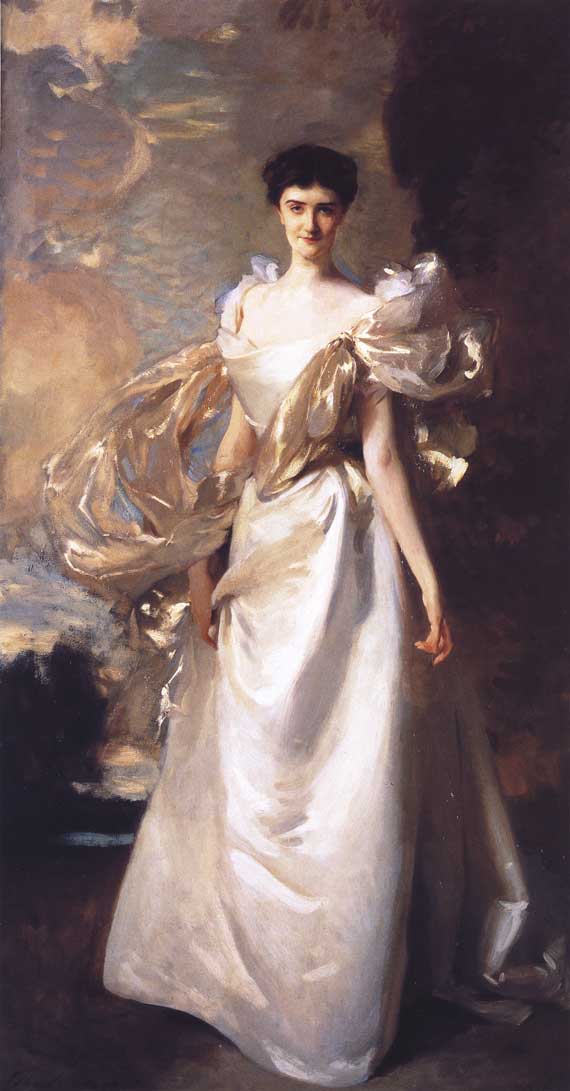
Margaret "Daisy" Leiter by
John Singer Sargent
Back briefly to the Leiter family, who were quite extraordinary in their own right. All the sisters went British. Nancy Leiter became the wife of Lt Colonel Colin Campbell and was known as America's most beautiful woman for a time. She met Campbell while visiting her sister Mary in India.

The other Leiter sister Margaret, better known as Daisy, was also a successful buccaneer. She married Henry Howard, the 19th Earl of Suffolk (and 15th Earl of Berkshire) in 1904.

In 1931, the Leiter family was divided when Daisy sued her brother Joseph over his mismanagement of their father's multi-million dollar estate. The lawsuit dragged on for eight years and racked up over a million dollars in court and attorney fees. Though Joe's tastes were extravagant (he famously purchased some 50 dozen pairs of silk socks and at one point tried to buy the Great Wall of China), the court refused to intervene since he had managed to increase the estate's working capital from 12 million to 17 million. However, when a special audit was conducted six weeks later, Joseph voluntarily resigned. When he died the next year, his personal estate was worth a million dollars. Daisy was still living in London when a 1937 Time Magazine article documented the trials and tribulations of the fabulous Leiter family.

Tuesday, September 18, 2012

The Gilded Age or My Homage to the Vanderbilts

Biltmore, ca. 1900
I've always been fascinated by the Gilded Age. The clothes were luscious (if you didn't mind being trussed up like a turkey), the houses were huge, and being socially mobile was all the rage. I grew up taking day trips to the Biltmore Estate in Asheville, North Carolina (I highly recommend a visit to both the estate and the city...fabulous architecture, awesome food, and good beer...what else could you want?) and so my childhood fantasies were filled with thoughts of the Vanderbilts. Even though I have visited the estate mulitple times, I never get tired of it. In fact, my hubby and I paid a visit back in April and I was finally able to see the gardens in all of their spring glory thanks to a particularly warm winter. They've added many new features including period clothing to some of the rooms and we were lucky to catch the opening of a new history exhibit that satisfied my obsession for all thing Vanderbilt.


For those of you not familiar with Biltmore, it was built in the 1890s by George Washington Vanderbilt, the grandson of the original Robber Baron, Cornelius Vanderbilt. I don't really think he did anything besides inherit millions of dollars (OK, apparently he managed the family farm in upstate New York). He was rather sickly and upon a visit to the Asheville area, he decided that a mountain estate was just what he needed for his health. He commissioned Richard Morris Hunt (my favorite architect of the era) to design the house and Frederick Law Olmstead (yes, that Olmstead...of Central Park fame) to do the gardens. Ten years later, George moved into the palatial estate, along with his wife Edith Stuyvesant Dresser, a pedigreed old New Yorker who was raised in Paris. Her fabulous portrait by Boldini hangs in the house. She was quite tall apparently!

The house today remains intact and owned by Vanderbilt's grandsons. It is also the largest privately owned residence in the US and I am always marveled by how the family has turned such a palatial estate into a million dollar business.

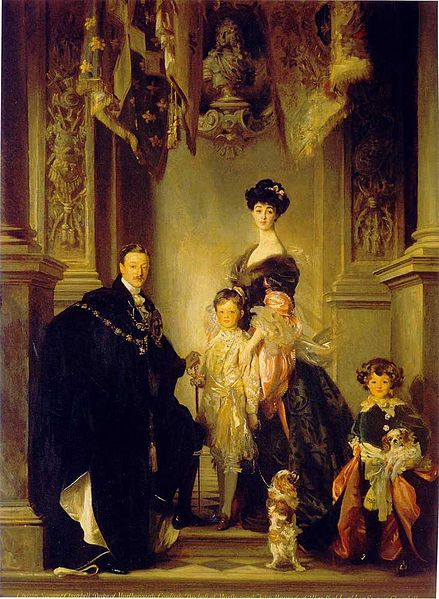
Lovely family portrait of the Marlboroughs
by John Singer Sargent

As I grew older and my interests began to extend to all things British, I became fascinated by another Vanderbilt--Consuelo, the Duchess of Marlborough. She was George's niece, the daughter of his brother William Kissam Vanderbilt and the pugnacious Alva Erskine Smith, who from all accounts was someone you did not want to cross. I've been reading To Marry An English Lord: Or How Anglomania Really Got Started and it details all of Alva's machinations to obtain entree into New York society (it's a tongue and cheek account of the time period...very funny). Consuelo was named after her mother's BFF, Consuelo Iznaga, who was one of the original "Buccaneers" -- she married the Viscount Mandeville who eventually became the 8th Duke of Manchester.

It was fitting that Consuelo Vanderbilt became one of the second generation "Buccaneers". She married Charles, the 9th Duke of Marlborough, though sadly, their marriage was loveless at best. She gave him "the heir and the spare" and checked out around 1906 with their divorce being finalized in 1921. She went on to marry the French aviator Jacques Balsan, who incidentally, was the brother of Etinenne Balsan (one of Coco Chanel's early lovers). Small world!

Consuelo was recently used as a model for Cora Cash in Daisy Goodwin's novel "The American Heiress". Many of the incidents (domineering mother, a secret engagement) in the book were ripped from Conseulo's own autobiography "The Glitter and the Gold".

That's enough for today. I might detail more on the other Buccaneers (including Consuelo's aunt-in-law Jennie Randolph, mother of Winston Churchill) at a later date.